Site 1
Fruiting vegetables
Tomatoes, sweet peppers, cucumbers and eggplant for homes, hotels and cruise ships.
Planned: about 250 t a yearStatus: candidate area, not secured land1
A plan for five smart farm sites on Saint Kitts and Nevis. Explore the islands, then fly down into each site.
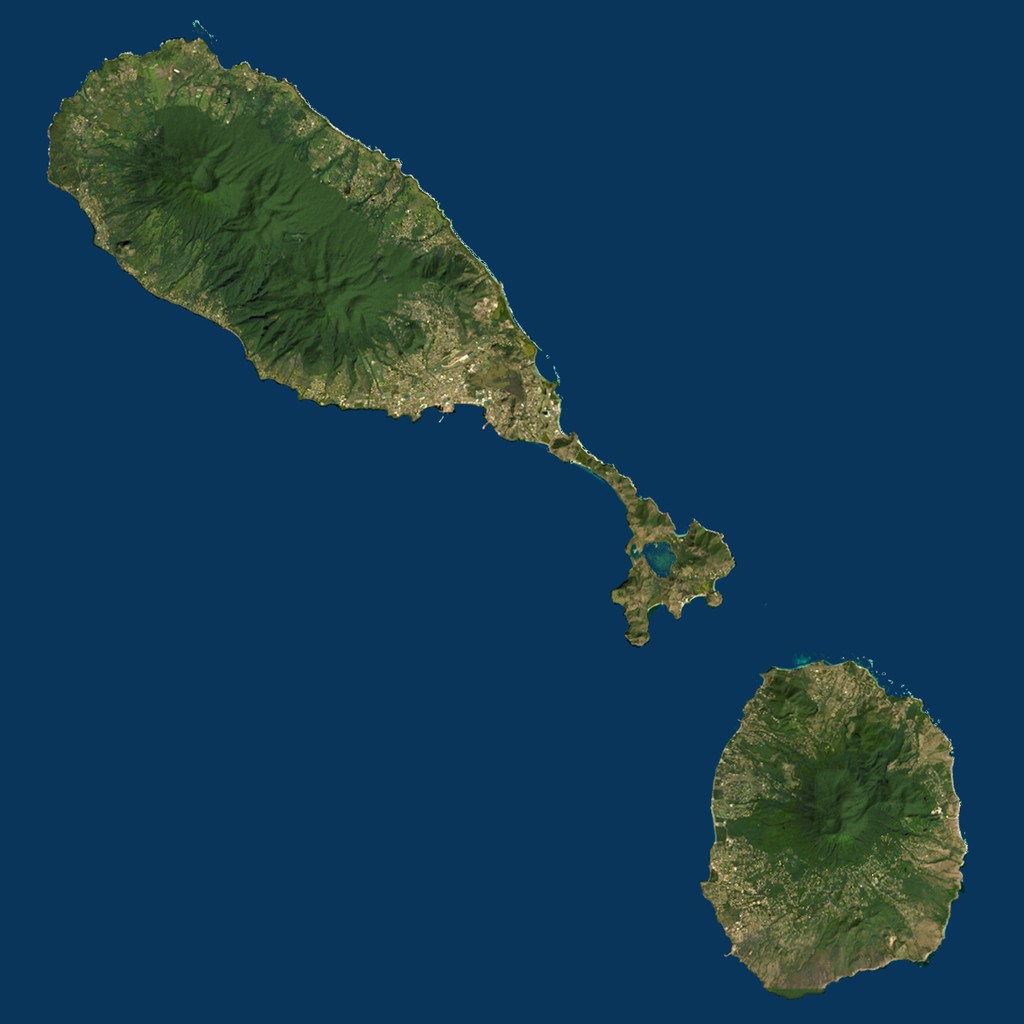
Our plan is five 5-acre sites across Saint Kitts and Nevis. Each has three acres of greenhouse, five vertical-farm containers, its own solar power, battery and rainwater, a visitor centre and shop, and runs 24 hours a day. Four grow food the Caribbean imports today; one is planned as a medicinal cannabis site, subject to a licence. Pick a site in the model above to explore it.
Saint Kitts and Nevis buys most of its food from abroad. The Ministry of Agriculture has put the yearly food import bill at about EC$140 million and set a goal of cutting it by a quarter, about EC$35 million. A 2023 survey by CARICOM and the World Food Programme found that about half of people in the English-speaking Caribbean were food insecure.
Twelve acres of food greenhouse is enough to change that for fresh produce. Our estimate is about 670 tonnes a year, worth around EC$6.7 million at wholesale prices, nearly a fifth of the national goal. Crops the islands cannot eat themselves, such as hot peppers, herbs and berries, become exports to neighbouring islands and beyond.
Fresh vegetables and fresh fruit are both on the list of fastest-growing imports into the Caribbean. Most arrive from Florida after days in a container. A grower inside the region can deliver in one or two days by sea or air, with less waste and no long-haul freight.
The first market is Saint Kitts and Nevis itself: shops, hotels, restaurants and cruise ships. The next are neighbours a short hop away that import almost all their fresh produce, such as Anguilla, Sint Maarten, Antigua and the Virgin Islands. After that come the larger CARICOM markets, which trade duty-free with each other.
Prices from US suppliers have been rising with tariffs, and regional business groups are urging members to buy from each other. That makes this a good time to offer a Caribbean-grown alternative.
| Need | What the plan offers |
|---|---|
| Steady supply | Picking every day of the year, not one season |
| Storm resilience | Impact-resistant cover; own power and water after a hurricane; five sites, not one |
| Dry-season supply | About 10 million litres of rain caught at each site a year |
| Other farmers | Seedlings, soil data, pest warnings and shared water for surrounding farms |
| Young people | Technical farm jobs in automation, energy and hydroponics |
| Foreign exchange | Less spent on imports, more earned from exports |
Splitting the crops means each site can specialise, staff learn one job well, and a storm or pest at one site does not stop the others. Four sites cover the vegetables and fruit the islands import most and add food crops worth exporting. The fifth is planned as a medicinal cannabis site, subject to a licence, kept fully separate from food. Three sites are on Saint Kitts and two on Nevis.
See each island in 3D, with its real streets and candidate areas: St Kitts in 3D Nevis in 3D
Tomatoes, sweet peppers, cucumbers and eggplant for homes, hotels and cruise ships.
Planned: about 250 t a yearStatus: candidate area, not secured landLettuce, kale, spinach and rocket daily, plus basil, mint and thyme packed for air freight.
Planned: about 200 t a yearStatus: candidate area, not secured landA planned, fenced and guarded site growing medicinal cannabis and nothing else, for patients here and for export.
Planned: up to 7 t dried flower a yearStatus: candidate area, not secured landStrawberries, cantaloupe, honeydew and watermelon, fruit that is flown in today.
Planned: about 90 t a yearStatus: candidate area, not secured landScotch bonnet and seasoning peppers, ginger and turmeric, sold fresh and for sauces.
Planned: about 130 t a yearStatus: candidate area, not secured landThe greenhouse is planned in galvanised steel and twin-wall polycarbonate, with insect netting on every vent. Inside there would be trellised vines in coconut coir, vertical hydroponic towers, A-frame gutters and floating beds. Five LED-lit containers would grow leaf crops and young plants in stacked layers.
See the greenhouse in the modelThe plan is for 792 two-sided panels on the greenhouse roof and a 1,000 kWh battery yard. The site is planned to run on its own power through the night and keep running when the grid is down.
See the solar roof in the modelThe roof would fill a 2 million litre pond. A dosing room would hold nutrient strength and pH steady, and drain water would be cleaned and reused.
See the water system in the modelBattery-powered sensors would report every ten minutes to one mast by long-range radio: 2 to 5 km among hills, 10 km or more with a clear view. Vents, shade, irrigation and dosing would respond automatically, and neighbouring farms could join the network.
See the sensors and mast in the modelOur farm research and our energy research are designed to run on the same technology. A soil probe in a greenhouse bay and an electricity meter on a building would do the same job: each would take a reading every ten minutes and send it to the site gateway. From there the readings would go to one Carib platform, which would store them, compare them with the weather and decide what to do. So the system that would open a roof vent on a hot afternoon is the same one that would tell us how much solar power a site made, used, stored and sent to the grid.
In the model, every building carries a meter cabinet with a status light, the inverters hang on a wall at the battery yard, and the data room sits beside the control room. Open a site, choose Walk in or Guided tour, and stop at the Energy meters, Data hub, Water quality and Pest watch signs to see each part at work.
This is our planned design, and the readings in the model are modelled, not measured on a site. Estimate: 36 reporting devices at one site, each sending 144 readings a day, is about 5,000 readings a day, and about 9.5 million a year across the five sites.
A modelled week, not a forecast. The chart shows what one site's 792 roof panels would generate from 14 Nov to 20 Nov, how much power the site uses, and when rain refills the pond. Choose a time on the chart to move the model's clock there; moving the clock under the model moves the line on the chart.
| Time | Solar output, kW | Site use, kW | Rain, mm an hour |
|---|
Weather: sample week, 14 to 20 Nov 2026. Two days use the sky reported at the island's airport; the other five are a typical-season estimate. Not a record of the site.
How this is worked out: the sun's height is calculated for 17.30°N, 62.72°W on each date. Output assumes 436 kW of panels with 22% losses. The site is assumed to use 45 kW all night and 80 kW by day, about 1,500 kWh a day. A 1,000 kWh battery covers the night. Selling surplus power needs an agreement with the electricity utility.
Phase 1 opens each site for about US$1.2 million: the first acre of greenhouse, two containers, 150 kW of solar, a 400 kWh battery, and the full water, packing and security set-up. It can sell produce from the first season. The full build adds the other two acres of greenhouse, three more containers, and takes solar to 436 kW and the battery to 1,000 kWh. We estimate about US$2.7 million a site in total, or US$13.7 million for all five. Land is not included.
| Item | Phase 1 | Full build |
|---|---|---|
| Greenhouse shell | 142,000 | 425,000 |
| Growing systems | 61,000 | 182,000 |
| Foundations and assembly | 49,000 | 146,000 |
| Vertical-farm containers | 140,000 | 350,000 |
| Solar | 195,000 | 566,000 |
| Battery | 120,000 | 300,000 |
| Pond, pumps and irrigation | 80,000 | 120,000 |
| Sensors, automation, control room | 70,000 | 90,000 |
| Packing, cold store, trucks, security | 160,000 | 220,000 |
| Design, permits, grid connection | 70,000 | 100,000 |
| Contingency, 10% | 109,000 | 250,000 |
| Total for one site | 1,196,000 | 2,749,000 |
| Work | People |
|---|---|
| Picking and harvest | 30 |
| Planting and crop care | 14 |
| Nursery | 10 |
| Packing and cold store | 12 |
| Security, three shifts | 12 |
| Automation and maintenance technicians | 9 |
| Delivery drivers | 8 |
| Vertical-farm operators | 6 |
| Cleaning and grounds | 6 |
| Management, agronomy and quality | 9 |
| Total across three shifts | 116 |
| Site | Output | Price | Prediction, US$ |
|---|---|---|---|
| Site 1 · Fruiting vegetables | 250 t | $2.60/kg | 650,000 |
| Site 2 · Leafy greens and herbs | 200 t | $4.50/kg | 900,000 |
| Site 3 · Medicinal cannabis | 2 t sold | $1.00/g | 2,000,000 |
| Site 4 · Berries and melons | 90 t | $4.40/kg | 400,000 |
| Site 5 · Hot peppers and spices | 130 t | $4.00/kg | 520,000 |
| Five sites | 4,470,000 |
| Source | Visitors | Price | Prediction, US$ |
|---|---|---|---|
| Site 3 · Medicinal cannabis | 15,000 | $35 | 525,000 |
| Each food site | 6,000 | $25 | 150,000 |
| Tours at five sites | 39,000 | 1,125,000 | |
| Produce and cannabis sales | 4,470,000 | ||
| All sales and tours | 5,595,000 |
| What is counted | Low prediction | Middle prediction | High prediction |
|---|---|---|---|
| Produce and cannabis sales, five sites | 2,400,000 | 4,470,000 | 8,050,000 |
Each site has a visitor centre and shop by the gate. Guided tours take visitors past the vertical farms and the nursery and along the greenhouse walkway, on marked paths kept apart from the working crews.
The four food sites sell produce picked that day. At Site 3 the visitor centre explains how medicinal cannabis is grown, tested and tracked. The dispensary is for registered patients only; visitors cannot buy there. All of it is subject to a licence.
Saint Kitts and Nevis already welcomes cruise and stay-over visitors looking for things to do ashore. A working high-tech farm gives them something new, and brings a second income to every site.
Saint Kitts and Nevis now has a legal medicinal cannabis industry. The Medicinal Cannabis Authority was launched in April 2025 under the Cannabis Act, and licences cover cultivation, processing, export, research and testing. The Authority has said its national seed-to-sale tracking system is being put in place before the first commercial licence is issued.
We plan Site 3 as a cannabis-only facility. No food is grown there. The site design already gives the crop what it needs: a fenced site with guards on every shift, cameras and a staffed control room, climate control, sensors in every bay, and its own power and water.
Saint Vincent and the Grenadines shows what is possible and what is hard. It made its first export, to Germany, in January 2022, and its regulator reports more than EC$60 million of private investment and hundreds of jobs. But export sales from the Caribbean to Europe have since fallen, and regional banks have been cautious about serving the industry. Finding buyers, not growing the crop, will decide what this site earns.
| Part | What is planned |
|---|---|
| Licences | Cultivation, with separate licences for processing and export |
| Mother plants and cuttings | Two bays keep the plant varieties and raise young plants |
| Growth bays | Two bays where young plants build size under long days |
| Flowering bays | Five bays with blackout screens to control day length |
| Drying and curing | Humidity-controlled rooms and a locked vault |
| Quality standards | Good agricultural practice for growing; pharmaceutical-grade processing for European buyers |
| Tracking and testing | Every plant, batch and payment recorded in the national system; independent lab tests on every batch |
This is an outline, not legal advice. We have not applied for a licence. Whether a site of this size can be licensed, and what conditions apply, has to be confirmed with the Medicinal Cannabis Authority.
These regional strategies and funds share the plan's goals. Whether we qualify, and when calls open, has to be confirmed with each one.
The regional goal to cut food imports by 25%, now extended to 2030. Saint Kitts and Nevis has adopted it as national policy.
Fit: local produce that replaces imports.The ten-year OECS food and agriculture plan. Its current priorities are private-sector development, transport and trade, and climate-resilient farming. Flagship projects for 2025 to 2027 include solar-powered cold storage and irrigation hubs and a digital food dashboard.
Fit: each site is a solar-powered cold storage, irrigation and data hub.A €5 million EU-funded food security programme for the six OECS countries, run by FIAP and CPVA with the OECS Commission. It has issued grant calls for civil-society groups; the last one closed in January 2026.
Fit: youth association partners could apply to future calls.A national project being prepared through the Caribbean Community Climate Change Centre to widen farmers' access to climate-smart technology and training.
Fit: a ready demonstration model for the technology strand.A proposed US$14 million programme led by the Caribbean Development Bank for Antigua and Barbuda, Saint Kitts and Nevis, and Saint Vincent and the Grenadines.
Fit: water storage and protected cropping.FAO is supporting greenhouse farming in Saint Kitts and Nevis through its Technical Cooperation Programme. The GEF Small Grants Programme funds community environment and livelihood projects here.
Fit: training partnerships and community-level pilots.We want to partner with landowners, youth associations, farmers' groups, ministries and funders across the OECS to build and test this model.